
Insights
Self-Directed IRA vs. Taxable Brokerage Account
Sep 10, 2026 | Read time: 7 minutes

Insights
Sep 10, 2026 | Read time: 7 minutes


If you own a self-directed IRA (SDIRA), you already know it can open the door to investments such as real estate, precious metals, private placements, and other alternative assets that are typically unavailable through a standard brokerage IRA. But an SDIRA is not necessarily a replacement for a taxable brokerage account. The two serve different purposes and can work together as part of a broader financial strategy. Understanding how each works can help you make informed decisions based on your retirement goals, liquidity needs, and investment preferences.
An SDIRA is still an IRA and follows the same tax-advantaged structure as traditional retirement accounts. A Traditional IRA may allow eligible individuals to take a tax deduction for contributions while benefiting from tax-deferred growth. A Roth IRA does not provide a deduction for contributions, but qualified distributions are generally tax-free in retirement.
What sets an SDIRA apart is the broader range of alternative investment options it can hold. Depending on the custodian and investment type, investors may use an SDIRA to hold assets such as real estate, private equity, private lending, precious metals, and other alternatives.
That expanded flexibility comes with increased responsibility. SDIRA owners must ensure their investments comply with Internal Revenue Service (IRS) rules, avoid prohibited transactions, and manage assets that may be less liquid and more difficult to value than publicly traded securities.
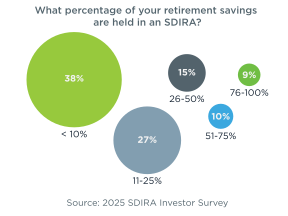
Many investors view an SDIRA as one component of a diversified retirement strategy rather than an all-or-nothing approach. Results from the STRATA's 2025 SDIRA Investor Survey suggest that investors often balance SDIRA holdings alongside other retirement assets, allowing them to pursue alternative investments while maintaining diversification across account types and investment categories.
A taxable brokerage account, on the other hand, offers greater flexibility and access to your money. There are generally no annual contribution limits, required withdrawal schedules, or IRS penalties for accessing funds before retirement age. Investors can add or withdraw money as needed and typically have access to a broad range of publicly traded investments, such as stocks, bonds, mutual funds, and ETFs. This flexibility can make a taxable brokerage account useful for investing beyond annual retirement account limits or for financial goals where access to funds may be important.
Side-by-side comparison
| Feature | Self-directed IRA (SDIRA) | Taxable brokerage account |
| Tax treatment | Tax-deferred growth (Traditional) or potentially tax-free qualified distributions (Roth) | Taxable interest, dividends, and realized capital gains |
| Contribution limits | Annual IRA contribution limits apply | No contribution limits |
| Withdrawal rules | Early withdrawal penalties may apply before age 59½; Required Minimum Distributions (RMDs) may apply to Traditional accounts | No IRS early-withdrawal penalties or required distributions |
| Investment flexibility | Alternative assets such as real estate, private equity, private lending, and precious metals, subject to IRS and custodian requirements | Typically focuses on publicly traded securities such as stocks, bonds, ETFs, and mutual funds |
| Prohibited transaction risk | Yes, under IRC Section 4975 | No |
| Liquidity | Often lower, particularly for real estate and private investments | Generally higher |
| Access to funds | Restricted by retirement account rules | Accessible at any time |
For investors interested in alternative assets, an SDIRA provides the opportunity to hold investments that may not be available through a conventional brokerage IRA. For example, an investor with experience in real estate may want to use retirement funds to invest in rental property or other real estate opportunities. Others may want exposure to private companies, private debt, or precious metals.
A brokerage account can also be held within a STRATA SDIRA, providing access to publicly traded investments and greater flexibility between alternative investments. This allows investors to keep retirement funds invested in more liquid assets while remaining ready for future opportunities—all within the IRA. The potential advantage is the ability to combine alternative and traditional investments with the tax benefits of an IRA.
There are important limitations. All assets in an SDIRA are owned by the IRA, not by you personally, and transactions must follow IRS rules. Alternative investments can also be less liquid and more difficult to value. And, as with other IRAs, withdrawing funds before age 59½ may result in taxes and an additional 10% tax unless an exception applies.
A taxable brokerage account can be useful when flexibility and access to funds are priorities. Unlike an IRA, there is no annual IRS contribution limit, and funds can generally be accessed without waiting until retirement age. This can make a taxable brokerage account useful for shorter-term financial goals, investing beyond annual IRA contribution limits, or maintaining investments that can be more readily converted to cash.
The tradeoff is tax treatment. Interest, dividends, and realized capital gains may be taxable in the year they are received or realized.
Investment options vary by brokerage and investor eligibility. While publicly traded securities are commonly available, certain private or higher-risk investments may be limited to investors who meet specific eligibility requirements.
An SDIRA and a taxable brokerage account can serve different purposes within the same financial strategy. An SDIRA may be appropriate for longer-term retirement investments where tax-advantaged growth is important. A taxable brokerage account may provide greater liquidity and flexibility for investments or funds you may want to access sooner.
Using both account types can also provide greater flexibility when unexpected expenses arise. Having accessible funds outside an IRA may reduce the need to take an early retirement distribution and potentially incur taxes or penalties. STRATA’s 2025 Self-Directed IRA Investor Survey found that 38% of respondents held less than 10% of their total retirement savings in an SDIRA, illustrating how an SDIRA may represent just one component of an investor’s broader retirement savings strategy.
STRATA's IRA Comparison Calculators can help you compare taxable and tax-advantaged growth scenarios and see how factors such as taxes, contributions, and time may affect long-term results.
There is no one-size-fits-all answer. An SDIRA and a taxable brokerage account serve different purposes, and the right approach depends on your financial goals, investment experience, risk tolerance, time horizon, tax situation, and need for liquidity. A qualified financial or tax professional can help you determine how each account type may fit into your overall strategy. To learn more about the investments you can hold in a STRATA SDIRA, explore our Investment Options page.
A Self-Directed IRA (SDIRA) is a tax-advantaged retirement account that allows investment in alternative assets, while a retail account is a taxable brokerage account that offers greater liquidity and fewer restrictions on withdrawals.
 Back to all